• español
  • English
Universidad de La Laguna
  • Contact
    • Contact form
    • Phone numbers
    • riull@ull.es
  • Help and support
    • University Library
    • Information about the Respository
    • Document upload
    • Support to research
    • español
    • English
    • español
    • English
  • Login
JavaScript is disabled for your browser. Some features of this site may not work without it.
Universidad de La Laguna

Browse

All of RIULLCommunities & CollectionsBy Issue DateAuthorsTitlesThis CollectionBy Issue DateAuthorsTitles

My Account

Login

Statistics

View Usage Statistics

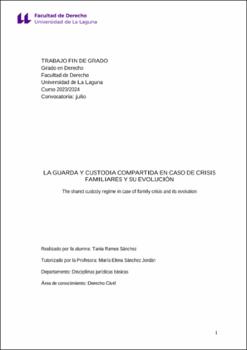
La guarda y custodia compartida en caso de crisis familiares y su evolución.

Thumbnail
View/Open
Export Citations
MendeleyRefworks
Share
Collections
  • TFG. Derecho
Complete registry
Show full item record
Author
Ramos Sánchez, Tania
Date
2024
URI
http://riull.ull.es/xmlui/handle/915/39575
Abstract
Before Law 15/2005, of 8 July, through which the joint custody regime was introduced in our Civil Code, this established that the general rule was the adoption of sole custody in favor of one of the two parents. However, after said Law, shared custody is considered another model of custody, which has generated certain debates that the Supreme Court has been in charge of resolving by establishing that said regime is normal and even desirable as long as it protects the best interests of the minor. In this work we will mention the different types of guard and custody that exist, but we will especially study shared custody, analyzing the different models of this; its legal and jurisprudential evolution; the principles on which said regime is based; the criteria established by the Supreme Court that will be taken into account for its adoption and, finally, the causes for denial of shared custody.
 
Antes de la Ley 15/2005, de 8 de julio, a través de la cual se introdujo el régimen de custodia compartida en nuestro Código Civil, este establecía que la regla general era la adopción de la guarda y custodia exclusiva a favor de uno de los dos progenitores. No obstante, después de dicha Ley, la guarda y custodia compartida pasa a considerarse un modelo más de guarda y custodia, lo cual ha generado ciertos debates que el Tribunal Supremo se ha encargado de zanjar estableciendo que dicho régimen es normal e incluso deseable siempre que con ello se proteja el interés superior del menor. En este trabajo mencionaremos los distintos tipos de guarda y custodia existentes, pero estudiaremos especialmente la guarda y custodia compartida, analizando los distintos modelos de esta; su evolución legal y jurisprudencial; los principios en los que se fundamenta dicho régimen; los criterios que el Tribunal Supremo ha establecido que se tendrán en cuenta para su adopción y, por último, las causas de denegación de la custodia compartida.
 
Web ULLTwitterFacebook
Universidad de La Laguna

Universidad de La Laguna

Pabellón de Gobierno, C/ Padre Herrera s/n. | 38200 | Apartado Postal: 456 | San Cristóbal de La Laguna, Santa Cruz de Tenerife - España | Teléfono: (+34) 922 31 90 00